• About

A Louder Silence

~ Victoria Borland vs. the 20th Century

A Louder Silence

Monthly Archives: May 2013

Second Homes, Second Acts

28 Tuesday May 2013

Posted by victoria in Introduction, Kenny Institute, Society

≈ 1 Comment

Tags

background, EKI, elizabeth kenny, introduction, narratives, society

There is a lot of amazing stuff, in the stack of ludicrously heavy filing boxes that make up the Minnesota Historical Society’s “Kenny Papers.”  But one of the more arresting parts of the collection is a thick folder of letters, newer than most of the things housed there, and without their musty smell and air of fragility.

Some of the letters are written by hand, in the beautiful looping calligraphy kids don’t learn anymore; I certainly couldn’t replicate those effortless, soaring curves.  Others are tapped on typewriters, or printed in erratic monospace font, spat out unceremoniously by early word processors.  They come on paper of every imaginable color and size, some intricately folded, others not at all.  There are short ones, barely a paragraph, and ones that seem to go on forever, and it’s obvious that none of them say anywhere near as much as they could.  Some are creased razor-sharp, the lines so straight they seem to have been written across a ruler; others sprawl and squirm, thick paper rippled by moisture, the residue of sweaty hands or falling tears.

I’d swear that even after all this time–exactly as many years as I’ve been alive–some of them still carry a faint whiff of elegant perfume.

They’re letters written about the still-extant Sister Kenny Rehabilitation Institute on its 50th anniversary in 1992, when a prominent Minneapolis newspaper asked former patients to contribute their memories of the time they spent there.  And the differences are semantic, because the content of every single one is the same.  I’ve never seen the initial request, but it must have been restricted to the very earliest patients, from the forties and very early fifties, the ones who knew Sister Elizabeth Kenny personally.  Or maybe they were simply the ones who felt moved to write in en masse.

The letters are incredibly, unreservedly warm, and to a one palpably grateful.  These people, fifty years later, remembered their time at the Insitute—or “Kenny,” some of them called it, “my time at Kenny”—with nostalgia almost unto joy.  The time they had spent as inpatients in that squat little building in the heart of Minneapolis was time they’d come to treasure.  And they wanted, so exuberantly, so delightfully, to tell their stories.  To explain how their brimming, happy lives had played out, and thank everyone involved, even though so much time had gone by that most of the Institute’s original staff had passed away.

It’s fantastic.  There really isn’t any other word for it.  I came to these things after months immersed in the kind of desperate material I spoke at length about in the last few posts, a world drenched in fear and viewed perpetually in the negative: with the deep pessimism of resignation, and in garish, otherworldly colors.  I saw none of that here.  And what I saw instead enchanted me.

Who in the world was this woman, I wanted to know, and what was so different about this place?

As it turns out…that depends very much on who you ask.

Even though I’ve been researching her story for upwards of a year now, I’m still trying to tease out fact from fiction, and half-truths from the ones so complete they’ve been embellished into legend.  It’s one of those stories, the best kind: where the most hyperbolically ridiculous statements are the ones most likely to prove true, and the ordinary things, the ones that establish a simple, everyday rhythm of life, are the toughest to pin down.

The lives of extraordinary people aren’t so different from anyone else’s, day in and day out.  But those aren’t the things people remember.
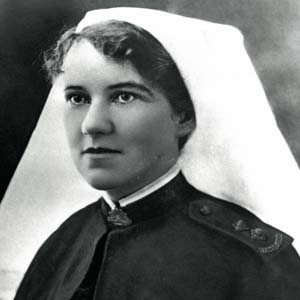
Kenny_Elizabeth_SisterBorn in 1880, Elizabeth Kenny grew up in rural Australia, part of a large, rambunctious family with a formidable number of children.  Easily the most fearless and outgoing member of an already free-spirited group, when she broke her arm as a teenager, she convinced the doctor who set the bone to take her on as an apprentice.  (Though she would later claim various nursing certifications, this may be the only supervised medical training she ever got.)  After a couple of years spent working on and off for Dr. McDonnell, she ventured out on her own to serve as a “bush nurse.”  It was somewhere in the depths of these years, making house calls on horseback to families who lived dozens of miles from anything approaching “civilization,” that she started treating polio cases.

The story of her very first encounter with the disease is a great one, and I won’t tell it here, at least not right now.  But the crux of the story is contained in a single telegram sent by Kenny’s mentor, after the young, terrified nurse reached out for help.

“Infantile paralysis,” Dr. McDonnell told her.  “No known cure.  Do the best you can with the symptoms presenting themselves.”

And so Kenny did—and her young charge made a full recovery, along with the half-dozen others who fell ill in the outbreak.  She had no idea what you were “supposed” to do with polio patients, or even what was assumed to be wrong with them.  It’s a big leap, actually, from “this patient can’t move so well” to “this patient is paralyzed,” and in circumventing the conventional wisdom—not because she was rebelling against it, but because she didn’t know what it was—Kenny found loopholes and inconsistencies in that thinking that led her to an entirely different method of treatment.  Among other things, gentle exercise took the place of immobilization, and intense heat therapy stood in for bizarre drug injections—and the results were spectacular.  (I am being, here, intentionally vague; a further explanation of these competing treatments, and the way Kenny’s approaches to neurology and psychology intertwined, is in the pipeline.)

With a couple of brief detours into other endeavors, Kenny worked from that point forward rehabilitating people with disabilities who had been written off as hopeless—not just polio patients, but also kids with cerebral palsy and other neuromuscular disorders.  As word of her method (and its effectiveness) spread, so did the controversy: she claimed to observe dramatically different symptoms than had been recorded by anyone else, the symptoms on which her method was based, and an air of self-righteous indignation started to gather around her.

One of my very favorite lines in her (spectacularly funny, and spectacularly fictionalized) first autobiography, published in 1943, tells you pretty much everything you need to know about her manner of interacting with others: “Some minds,” she says, “remain open long enough for the truth not only to enter but to pass on through by way of a ready exit without pausing anywhere along the route.”

This was not a clever aphorism devised to get a smile out of readers.  It was a philosophy by which she lived, and if she thought you suffered that particular affliction, she was not shy about telling you so.  A contemporary journalist might have called her the “Angel of the Outback,” but Elizabeth Kenny was hardly a saint.  (Nor was she a nun, despite being widely known as “Sister” Kenny; that was a title bestowed upon decorated nurses in the Australian army, where she served during the First World War.)
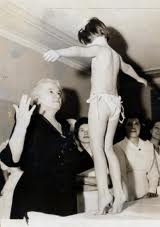
images-2Part of the reason I decided to do this project is the frequency with which people still try to discredit Kenny, on the rare occasions when the story is dragged out of the historical attic, and that modern prejudice is rooted in the ferocity of the original controversy.  Doctors loathed her, almost to a one, because everything about her rankled—her gender, her lack of credentials, the fact that she said they were wrong—and when they rebuffed her, she pushed back with equal ferocity.  She was right, obviously, and everybody else was not only wrong but also incredibly stupid.  (This is a diplomatic strategy that tends not to further negotiations.)

It wasn’t until 1940 that she landed in the United States, and there’s some confusion about why she ended up here in the first place.  To hear her tell it, she was sent by the Australian government and its public health counsel to spread her technique as a point of pride for her country; less generous accounts sometimes imply that they wanted very badly to get rid of her.  But after unsuccessful presentations at hospitals in New York and Chicago, just as she was about to return to Australia, she met a duo of sympathetic doctors from the University of Minnesota hospital…and it was in Minneapolis that the other side of the story blossomed.

Kenny might have been combative with doctors (and, when necessary, politicians, the press, and her own staff).  But to her patients, she really was something like a saint.  Gentle and attentive, she was their constant defender from a system that didn’t take them any more seriously than it took her.  They became co-conspirators, in a way, and it was an arrangement that seemed to strengthen everyone involved.  Kenny didn’t have time for anybody’s—well, it’s not exactly a family-friendly word.  But she always had time for her kids.

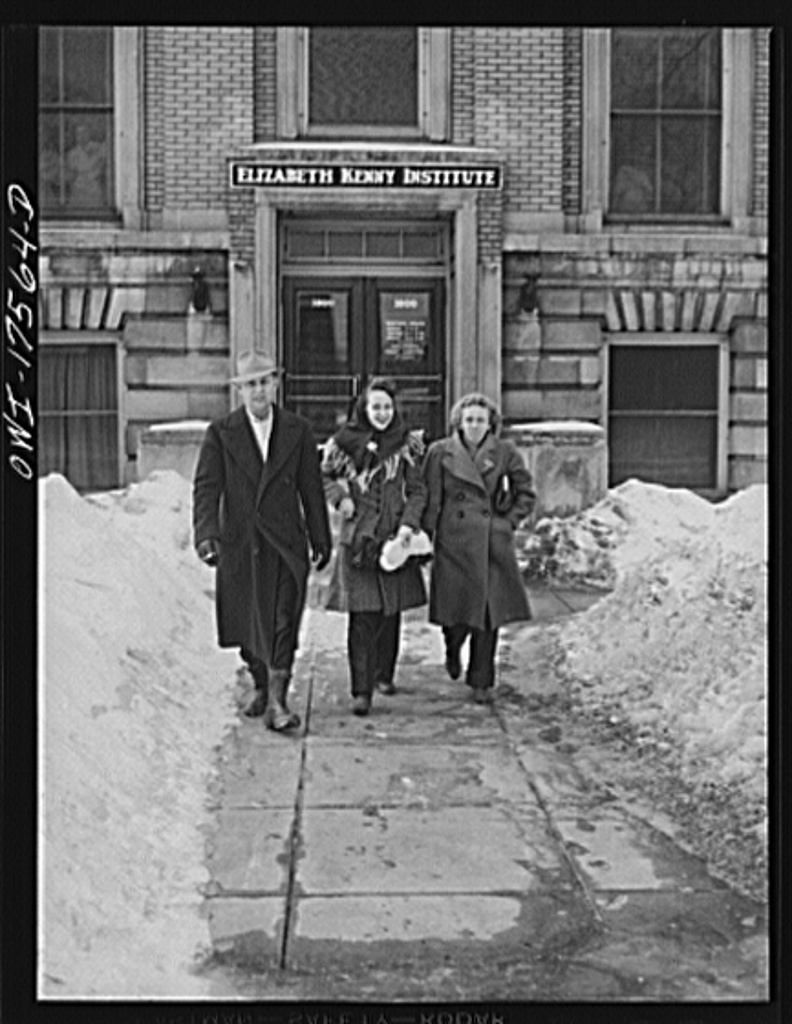
Russell Papenhausen, the gentleman I interviewed a few weeks back, who I’ve mentioned a couple of times, lights up when he talks about her.  At age fourteen, he was one of her first patients in Minneapolis, treated before the Kenny Institute (her very own 80-bed hospital, founded in 1942) even existed.  And he put it more simply, and with more authority, than any of my pretty words ever could.

“She was a marvelous woman,” he told me, breaking into a mischievous smile.  “She put the fear of Christ in the grownups and nothing but love in the youngsters.”
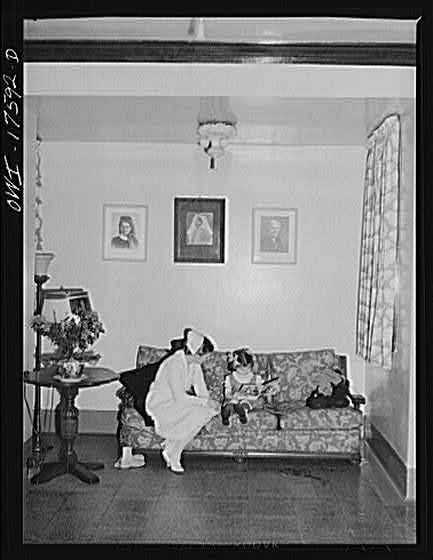
8d14023rThis was the one time that the patients’ voices won out, and, almost overnight, the beleaguered nation fell in love.  Everyone in a position of prominence during the height of the polio epidemics gathered around them many dozens of sycophants; Basil O’Connor, the (extremely reluctant) director of the March of Dimes, was lionized by many, chief among them President Roosevelt.  But not many people had letters sent to them asking, in all seriousness, “Would you let me know when it would be practical for you to receive a 15 lb. ham?”

A reporter named Inez Robb wrote the following, after her first visit to the Institute, with the breathless lack of objectivity endemic to midcentury journalism:

When I went out to the institute, I went up to visit a patient in the big ward which houses 29 boys ranging in age from 6 to 16.  When I came into the ward, I saw a sight that stopped me in my tracks.  Two lively kids of seven were wrestling vigorously in a hospital bed.  It was a rough and tumble scrap.

At that moment, the nurse reappeared.

“Tommy!  Johnny!” she said authoritatively.  “Stop that at once!  Tommy, you know you are not allowed out of bed.  Get back into your own this instant!”

The kids looked sheepish.  Tommy, a beguiling imp with big black eyes, got back into his own bed.

“Kids have so much pep,” the nurse said.  Kids with infantile paralysis with pep!  With too much pep!

“It seems like a miracle,” I said helplessly.

Kenny hated the word miracle—because it embarrassed her, she always claimed, and because it wasn’t true; I suspect it had more to do with the fact that it gave God credit she would have preferred to keep for herself.  But of course it seemed like a miracle.  It seemed like a miracle to the uncountable, unfathomable number of parents who had been told their child would never walk again, and to the children who’d believed their lives were forfeit—but for very different reasons.  In her baker’s dozen years in America, Kenny tiptoed, and sometimes blithely trampled, the vanishingly thin line between what society expected from a great healer of polio victims and the kind of compassionate care those people actually needed.

Kenny was beloved by the nation for the results she produced: the Kenny Institute’s recovery rate was vastly greater that of any other treatment facility’s—about three times higher than average.  More of her kids walked; eventually some ran and jumped and fought for our country in the Second World War (including my new friend Russell).  Few wore braces or endured the spinal curvature common among polio survivors; if they used crutches, they were the short forearm type known then as “Kenny sticks,” rather than the awkward underarm variety, the kind you were supposed to use when you broke an ankle, and which gained an extra sense of pathos in their permanence.  The science, however controversial, was sound; the therapy worked.  Kenny’s kids got better.

But her patients didn’t love her because she made them well.  They loved her because—against all odds, in a situation just once removed from the fires of hell—she made them happy.

sisterkennycakeI think my favorite thing in the Kenny papers—more touching than the huge box of thank-you letters, more chaotically revealing than the hundreds of disorganized photographs—is a box of newsletters, crudely typewritten sheets the patients at the Institute put out at various intervals in the 40s and early 50s.  They were sent out to kids’ families and circulated inside the clinic, blurry duplicates on brightly colored sheets of cardstock, rife with good-natured ribbing and inside jokes.  The young writers gossip innocently about their therapists and doctors and nurses, gush about the photography classes they’re taking or the movies brought in for them to watch, speculate about what they’ll do when they get out, who they’ll be when they grow up.  They tease with enthusiasm old friends who come back for outpatient visits, especially when their subpar performance in the checkup meant they’d have to come back for a kind of remedial stay.

Because, the authors declared, only half joking, they knew nobody ever really wanted to leave.

I find myself holding my breath while I read them, like suspending the present can take me back in time, or like if I wait long enough or attend closely enough I might be able to inhale the stale air, with its sweetly rancid scent of rambunctious kids at play.  There’s plenty of irony in the Kenny Stretch, and more than a little dark humor, but hardly anywhere do you see a forced smile.  Isn’t this such a weird, messed-up world we live in? they ask, unselfconscious, and wise beyond their years.  Isn’t this awful?  Aren’t we bizarre?

Yes.  And gloriously so.  Because their lives belonged to them, and them alone, and it’s clearer here than anywhere else.  Nobody else got to decide how they felt, or what they were afraid of.  They might have been far from home, stranded apart from everything they knew or understood, but this new world was one they were building themselves.

The Kenny Institute was no less of a microcosm than any other inpatient facility—more so, actually, with its tight restrictions on visitors, and conspiratorial sense of community—but it wasn’t a place where you waited for your life to start up again.  It was a place where you celebrated the life you still had, the one you were living, because someday was far away, and you were still exuberantly breathing right now.  Though she never stated it explicitly herself, it’s obvious that it wasn’t just Kenny’s therapeutic concept that differed from the norm.  Her philosophy was wildly different, too, and its core postulate was this: that recovery wouldn’t happen unless you were deeply invested in it yourself, and that in order to be willing to sink such physical and emotional effort into an outcome that was ultimately so uncertain, you needed to value yourself right now.

Her patients had to understand what they were working for, and that that work was something they did for themselves.  Not for some anonymous coalition of doctors who poked and prodded at your limbs and scribbled down incomprehensible numbers on a chart, who wouldn’t tell you if you failed.  Not for parents who worried that a lingering disability meant giving up on everything they’d hoped for you in life—not to mention what the neighbors would say, or how the checkbook would balance.  Not to keep up with siblings or friends or an amorphous notion of what it meant to have dignity.

And—perhaps most importantly—not even because Sister Kenny told you to.  Sister Kenny was not afraid of telling you to, and in no uncertain terms, but—unlike pretty much everyone else in the rehab community, at least according to the patients whose accounts I’ve read—she wouldn’t make you do much of anything at all.  If you couldn’t prioritize your own recovery, couldn’t take the initiative to focus on getting better—which meant deciding that getting better mattered, which in an uncertain world must have meant you mattered, at least enough to try—she knew she couldn’t force you to succeed, any more than those stubborn doctors could force her to shut up.

You couldn’t just choose to get better.

But you could choose to live.

Put even more simply: “back to normal” wasn’t under your control, or, however skilled her hands and gilded her reputation, Sister Kenny’s.  Recovery depended on factors no doctor or therapist could possibly foresee, on the degree of stripping in the wires, on the strength and stubbornness of your body.  But better—partly in the sense of performing “better,” to whatever degree you accomplished that, but also partly in the sense of feeling better, feeling safer, more whole—that was a choice.  And it was one you had to make; no one one else could make it for you.

That kind of responsibility was terrifying, especially to kids coming out of hospitals where they’d been treated as all but inanimate.  But it taught them to stand up straight—in more ways than one—without feeling like they were being puppeteered.  Not everybody remembers the Kenny Institute as a wonderful place to be, and it wasn’t an unconditional blessing for anyone.  The reality of this situation was impossible to ignore—even if it was, eventually, possible to escape—and patients were asked to face it head-on far more often under Sister Kenny’s care than at most other facilities. The physical and psychological demands she placed on children widely believed to be both incredibly fragile and uselessly damaged were enormous.  But those expectations were also an endorsement of personhood, and a gesture of respect, and for even the youngest of her patients, those confidences were transformative.

“You were lucky,” Russell’s wife told him, at the end of our second interview, after we’d fallen silent, exhausted, companionably sharing a plate of homemade cookies she’d brought.

He looked up, quizzical, in the middle of a bite.

“Not lucky to have polio,” Andree amended, waving a hand.  “But lucky she came along when you did.”

It was exactly the same sentiment expressed by the wire-service reporter I quoted earlier, in a different, later piece: the children of Minneapolis, at that particular juncture of history, were the “luckiest in the world.”

Not because they were safe; nobody in the world was that, in the midforties, from polio or anything else.  Not because there was nothing horrifying about their world, or because that world was free from danger.  Because they had the thing that we all so desperately need, and that so much of the rest of the country at that point lacked.

They had hope.  And more than hope, they had agency: the courage to find their own voice, and the fortitude to know that the only way to keep their illness from defining them was to write that definition themselves, before anyone else had a chance.
8d13994vThis is the story I’m telling.  And this is “A Louder Silence”: the embrace of volume, and clamorous voice, in the midst of a world determined to strip away all the noise.  The chattering static of undisguised reality, and the way it starts to sound like music, if you tilt your head just exactly the right way.  And the other kind of silence, lurking underneath such fearless self-expression: the ability to sit quietly inside yourself, to find some kind of peace, without needing to thrash away at endless, anxious insecurities.  To shout with joy, rather than defiance.

Of course, it’s not always that easy.  It’s probably never as easy as I just made it sound.  But it was possible.  It was beautiful.  And this silence deserves to be amplified.

Welcome home.
Standing Tall

25 Saturday May 2013

Posted by victoria in Introduction, Society

≈ Leave a comment

Tags

introduction, rehabilitation, society

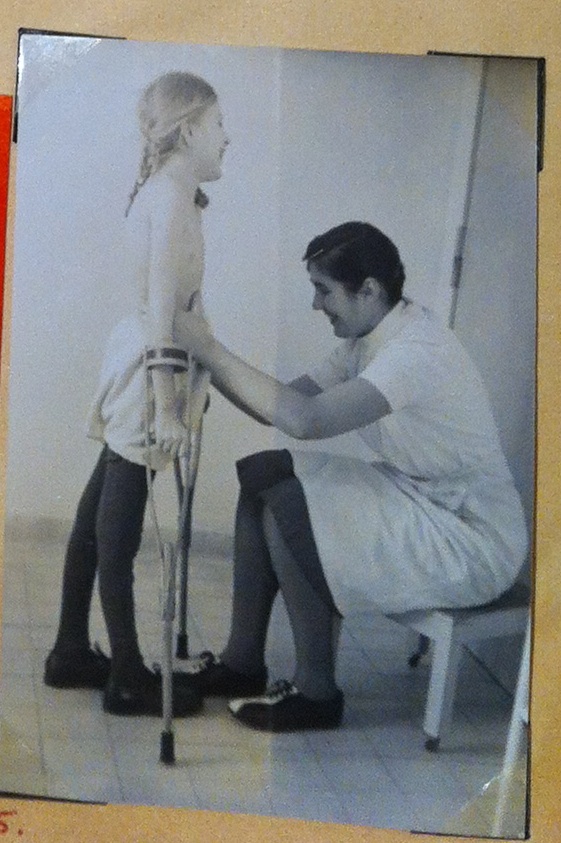
She is grim and anxious, captured in this set of black-and-white photographs.  Her small body rigid, she stands barely balanced on a pair of short forearm crutches, mouth set and sharp as a razor blade.  You can see how much she needs this step, and how hard her heart must be beating, keeping time with the shaking of her weak, tangled muscles as she moves.  Her therapist’s hands are light on her slender legs, her ankles and calves, moving them forward one at a time, showing her where to go, making the effort she is still too wrung out to manage by herself.  Her short hair is neatly braided, pretty and incongruously ordinary against the back of her neck.  She’s maybe eight years old, or a little older than that, and she looks exhausted already, holding the weight of the world in her small hands, eyes fixed straight ahead.

And then something changes.  I don’t know what happened in that moment, in the flicker of time between those shutter flashes (if shutters, or flashes, were even things cameras had back then).  I wish I could have been there, to see exactly what elapsed between the fourth and fifth snapshots.  But whatever it was—some whispered word of encouragement, or some feeling of triumphant familiarity—looking at that last picture is like watching the sun come up.  Standing there, laughing, she is radiant on those crutches, this skinny grade-school girl.  Elfriede Kohler is the happiest person in the world.

The day I saw that picture was the day I started to understand.  What I was really looking at, and what someday I would be writing about, and what it would come to mean, and the ways that it would change me.  Those photographs are the culmination of a lengthy scrapbook, lovingly assembled by someone at the clinic where Elfriede was treated, chronicling her progress from the depths of illness to partial recovery and discharge.  The brown kraft paper is rippled and torn, and pictures have fallen out here and there, leaving tantalizing holes in the story that the handwritten captions don’t quite manage to fill.

And I sat there in the library, feeling the weight of this book in my lap, as fragile and enduring as the girl it preserves, and I knew I never wanted to give it back.  Not just because the feelings were so profound.  Because—at least in part—I was starting to grasp just how incredibly rare they were.

Moments like Elfriede’s don’t come along very often, in these stories, but even when they do, they sit far down the line from the place we left off.  The illness was a dark, purgatorial space, after the before but just before the after, and no matter who you were, and what you might eventually achieve, the earliest forays into this new, unstable life were as terrible as anything that preceded them.

Polio’s paralysis is strange and unpredictable: its boundaries are fuzzy, its consequences vague, and, at least at the beginning, its permanence unclear.  Weakness powerful enough to put someone in an iron lung could abate entirely within weeks, but someone else’s comparatively inconsequential limp might never get better at all.  The effects are hardly ever symmetrical, nor are they especially well-contained: one side of the body is almost always much more heavily involved than the other, and even devastated limbs usually have some muscles that still work.

Even more uncannily, for all the glittering pins and needles of the illness itself, once the infection clears, sensation is rarely ever affected.  So much of the world stays intact: the feel of the damp sheets against your body, the nurses’ rough handling of your tight, aching shoulders, the bright-lit pain that still pulses through your body, random and blinding as lens flare.  It’s only your ability to interact with it that changes.

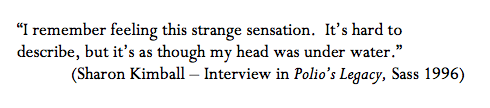
It doesn’t make sense, the straining that happens inside you, and the cruel disconnect between what you feel or imagine to be possible, and what you find really is.  Some people talk about a sense of disembodiment, like that part they can still sense but can no longer command or comprehend doesn’t even belong to them anymore.  More often, though, in recounting their experiences, people don’t talk about it at all.  They are lying desperately ill in the contagion ward, and then they are in therapy, transferred somewhere else to reboot, to get better.  The transition is so fast and so disorienting, and the things on either side of it so bold, that it doesn’t even stand out.

Every so often, someone will bring it up, often a little dreamily, like they’re only just realizing it’s true: I guess that was the last time I walked on my own.

Knowing seems to bring them comfort.

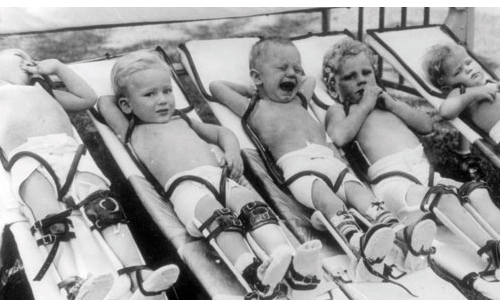
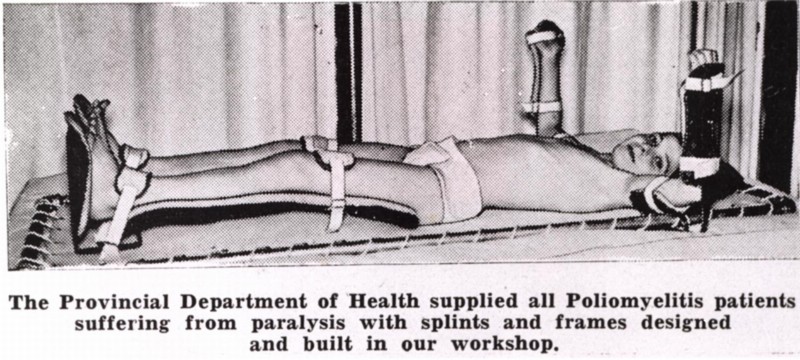
It was clear right away that something was terribly, terribly wrong, but it often took a long time to figure out just what it was.  The moment it was possible to endure being touched again, the doctors swarmed back in—more often than not to contain you, compress together all your pain and confusion and complicated feelings and literally bind them to your body.  Not just weeks but months of recovery were spent lying strapped down in bed, in an attempt to prevent further damage to weakened muscles.  Infants were put into body casts; older children and adults found themselves racked on “Bradford frames,” traction-like devices that held them stretched out, often with their arms at right angles.

“The immobilization is maintained for a period of eight weeks, aBradfordFrameHSC-AR1937-800t which time a second muscle test is made….  If exceptional improvement is shown, this immobilization…is repeated,” a prominent 1941 textbook, Dr. Philip Lewin’s Infantile Paralysis, instructed.  These eight-week periods were to be repeated indefinitely, but were “seldom continued for more than six to eight months.”

As if that’s no time at all.  As if everyone old enough to understand what was happening to them didn’t use that time to think about what would become of them after all this was over.  Didn’t lie in bed worried and helpless, and knowing all too well what would happen if it didn’t work.  If they didn’t get better.

People don’t talk about the transition, and those early days and weeks of recovery.  But they talk about the extremes to which they later went to fight for normalcy.  They talk about being haunted by a stigma they were desperately trying to avoid.

imgdisability_04lg

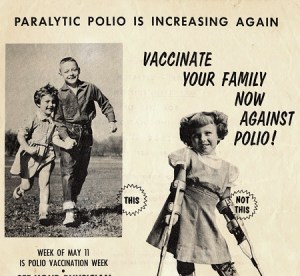
There’s a poster that’s frequently reprinted in historical retrospectives of the “polio years;” I first saw it in a 2005 exhibition at the Smithsonian Museum of American History in Washington D.C.  Created for a vaccination awareness campaign in 1956—the second summer the shot was available—it shows two different pictures, dramatically-split screened by contrasting backgrounds.  On the right stands a smiling grade-school girl in tight buns that bear a passing resemblance to Princess Leia’s, balanced awkwardly on wooden crutches, the angle of her slender arms calibrated to imply even more deformity than she seems to suffer.  On the left, two able-bodied children stride confidently through a field, wholesome hands intertwined.

This, the caption reads, above the happy siblings.  Not this, above the bravely grinning girl.  Vaccinate your family now

This.  Not this.  This.  Not this.

This was the world the many thousands of people paralyzed annually by the disease in the U.S. alone had to live in.

Every single depiction of polio, every warning against it, characterizes the disease as a hideous specter, sometimes literally so: in a film called The Crippler, produced by the March of Dimes, the illness moonlights as a grossly elongated shadow, looming darkly over unsuspecting homes.  Polio was horrifying, of course, and more than likely this visceral repulsion accomplished its objective: eliciting donations, raising awareness, and getting kids vaccinated, when that time came.  But in associating the illness with the grotesque, its victims were tainted that way, too.  As disgusting and contaminated, or else tragic and courageous, almost martyred, helpless young sacrifices to a noble cause.  We put these kids up on pedestals even as we shrank from them in terror.

Having polio no more made you brave than it made you broken.  It meant you were in the wrong place at the wrong time, that you shared the wrong ice cream cone or dove in the wrong swimming pool.  The poster child was a cultural fantasy, not a reflection of reality.

But how do you understand that, at four years old, or fourteen?  You’d seen those pictures, unless you’d been living under a rock since the day you were born.  You knew what it meant, to have had this happen to you.  And you knew that the only way to be okay again, to avoid being pitied or lionized, was to get better.  All the way better.  Even the kids in those posters knew it: “Help me walk again,” a picture of a child in a walker pled, and a happily skipping boy was triumphantly captioned, “Your dimes did this!”

Getting better became the only thing that mattered.  The only way to feel real again.  And not just getting better.  Getting well.

In the memthisformeoir Warm Springs, about her surgical rehabilitation at FDR’s famous polio hospital, Susan Richards Shreve recalls her younger brother asking if going in for reconstructive operations frightened her.

“I’m not scared,” she told him.  “The next time you see me, I’m going to be a different girl.”

“What kind of girl?” he asked her.

“A perfect one.”

It wasn’t just the specter of posters in shop windows and hyperbolic movie reels that made this seem so crucial.  It was the reality you lived, day in and day out, in most inpatient rehab facilities.  After the restraints finally came off, patients were often started on aggressive exercise regimes, hoping to strengthen them enough to get them back on their feet.  The goal, always, was sitting, standing, walking, no matter how much supportive bracing that required, or how much it might hurt.

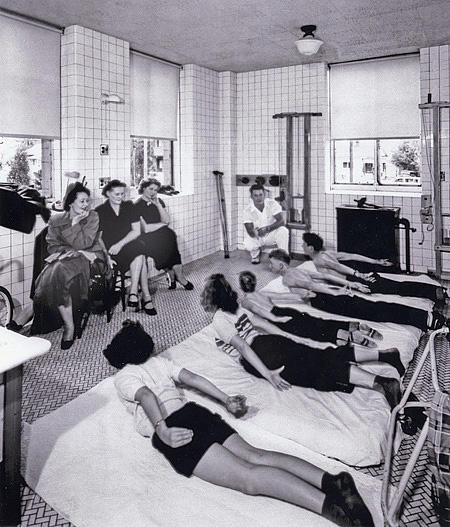
rehab_groupThe acceleration was dizzyingly brutal: kept from doing anything for so long, now you were expected to do everything, and the goal wasn’t really to make you feel better.  It was to achieve something as close to normalcy as possible, no matter how strenuously your weakened body protested, and when inevitably you ran up against something you really couldn’t do, it felt like your fault.  Like you’d failed somehow.

And once those insurmountable roadblocks were found, the limits of your natural recovery defined—at least as far as the (misguided, but we’ll get to that) doctors were concerned—the next step certainly wasn’t acceptance.  At a time when fighting to win at any cost—not just in the battle against polio, but in nearly every circumstance, great or small—was not only virtuous but expected, acceptance felt synonymous with giving up.  Encouraging someone to come to terms with their disability was unthinkable: if the patients didn’t feel adequately distressed about how they were doing, what reason would they have to keep struggling?

The next step, instead, was surgery.  Surgery to fuse bones, to transplant tendons from functional muscles to paralyzed ones, to shave down joints unhinged by muscle cramps.  Dozens of surgeries, sometimes, stretched out over years, trying to account for growth, and the pernicious influence of time.  For the most part, these procedures were designed not to make the patient feel more comfortable, but to make her more conventionally functional, closer to “normal”—whether or not that was something she actually wanted, or that her weakened body could support.

Lest you think I’m being hyperbolic, or exaggerating the extent to which recovery alone restored legitimacy, I want to share some excerpts from a March of Dimes pamphlet meant to “help” affected teenagers cope with the aftermath of their illness.  There’s no date that I saw on this slender, seemingly innocuous document, but I’d bet anything it came from the mid-40s, with both fear and determination at their most histrionic peak.

“Everyone has problems to solve.  Some are easy.  Some are hard,” it begins, with an understatment that feels almost deadpan.  “When you are ill your problems are more difficult to solve, more annoying, and many times you do not know where to turn for help.”

Then the language turns from merely patronizing to aggressively fraught with expectation: “it is…the function of the National Foundation to help you win your way back to health.”  You and your family are “fighting to defeat the effects of the polio virus insofar as human skill and knowledge can do so”—and human skill and knowledge were held in high esteem at the time, with the country deep in the throes of new American exceptionalism, awestruck by unfathomable advances like the atomic bomb.

“If this little book does help you to ‘learn the score,’” the introduction concludes, “if it helps you become better able to conquer your polio and return to a full and happy life, it will have done everything we hoped it would do.”

There is no space, in that tone of enforced cheerfulness (which continues, blithely, through the rest of the booklet), for anyone whose recovery is less than triumphant. There are only winners and losers, without space left to to carve out a life in between—when life in between was most often the reality you confronted.  No doctor ever asked a child when enough was enough, or how she felt about what was happening to her.  They certainly never asked the darkest, and perhaps most crucial, question: Do you even want to get better?

walk_again

It seems like an absurd thing to ask, doesn’t it?  Of course you’d want to get better. There was nothing redeeming, hardly even anything tolerable, about this illegitimized existence, lost in the darkness of constant discomfort, at the mercy of a system you didn’t understand.  But what the doctors failed to understand was this: rehab felt like a kind of limbo, a probationary period, where the rules and privileges of normal life were suspended.  It was the place where you stayed while you waited to find out if your sentence would be commuted, and as long as you were there, everything else seemed far away.  More often than not, the “real world” these kids were supposed to be fighting to rejoin seemed like nothing but a cruelly impossible dream.

It’s hard to convince yourself to work toward a goal with such a narrow definition.  A difficult but attainable challenge is motivating.  But it’s hard to imagine enduring that sense of futility, day in and day out.  Lying in bed able to move just an arm, or a couple of toes, knowing that walking, that better, that normal, was the goal, made every incremental victory along the way seem less a triumph than an unbearable reminder of you how far you had to go.

Even if they couldn’t articulate it, there had to be some part of them that understood the paradox in which they were now unwillingly complicit.  If you couldn’t get better, phyiscally speaking, but you had to get better, in order to win back your legitimacy as a human being, your right to take up the same space and breathe the same air as other people without inspiring revulsion or reverence, then what were you supposed to do?  There had to be something you could do.

And there absolutely was: you could deny it.

Not that it had happened; that would have been absurd, not to mention impossible, for someone in a wheelchair, or encased in a body brace.  But you could refuse to acknowledge that it had affected you.  You might be in the chair, but the chair wasn’t a part of you.  You were normal.  It was your disobedient body that was the problem, and that didn’t really need to have anything to do with you.  This whole thing was merely a formality, some kind of terrible joke, and you would reenter the world determined to prove that the real you was better than this chair you sat in.

At the end of the day, in order to be seen “just as yourself,” people felt forced to deny a huge, and hugely formative, part of who they had become.  What had happened didn’t fit into anyone’s plan, or anyone’s image of what they wanted for themselves.  But to refuse to alter that image at all, and to make a perpetual enemy of the crutches that held you up or the fingers that drifted uselessly at your side, created problems all its own.  Insisting that you were unaffected, unchanged, un-limited, was an understandable reaction, but it was also a profoundly disingenuous one.  Whether it came of the work ethic instilled in therapy, or developed as a defense mechanism to cope with the world thereafter, relentlessly having something to prove drove polio survivors to be—statistically!—much more accomplished than their healthy compatriots.  But it also delayed, and in some cases denied, their ability to find peace.

I’m not implying that anyone failed, or that what anyone did was wrong: these attitudes were adaptive.  Patients developed the skills they needed to live in a world that felt hostile and warped, out of line with all of their possible realities.  They believed what their doctors and nurses and parents told them, and what kids don’t?  What person doesn’t, under sufficient duress, cling to anything said with enough confidence and certainty?  They needed a way out of the terrible place bad luck had landed them, and that way was better.  At any cost.  Better was a solid, straightforward goal.  And that was comforting.

But there was another way.

It’s hard to give up that one clear goal, with its easy answers about who you are supposed to be and what you ought to want, and embrace uncertainty instead.  It’s hard to accept things as they are, and keep picking your way across the river one rock at a time, turning with the currents of the water, neither frozen motionless in terror nor so desperate to push forward that the rapids sweep you in and pull you under.  Rushing through the process was as impossible, and trying as disastrous, as lying back passively and giving up.  It wasn’t just your “wholehearted cooperation and obedience when working with the physical therapist” (and doctors, nurses, and parents—again, according to the booklet) that made the difference.  It was your ability to cooperate with yourself, and thereby learn to navigate the actual reality you lived in, rather than the one other people said you did.

It’s why I love that picture of Elfriede so much.  What shines out through her eyes isn’t relief, or hope for the future, visions of what might come next.  She isn’t dreaming of barefoot running or high school dances, or even setting down the crutches to stand on her own.  She’s just happy.  She’s found her feet again, and it feels amazing, and as far as she is concerned—she, and her grinning therapist, who seems equally delighted—in that moment that is enough.  At that moment it’s everything.

That feeling—and the fact that it’s possible—is as rare and precious as her smile.  The human spirit is astonishing, and it’s no surprise that some managed to evade the limitations pressed upon them, and navigate these labyrinthine preconceptions to make their way on strength of spirit—and an enduring sense of self—rather than pure force of will.  There are plenty of beautiful stories scattered across the smooth, impassive surface of this seemingly unscalable edifice.  But nowhere do they cluster as tightly as they do around Elizabeth Kenny—the nurse I mentioned in my first post, the one this book I’m writing is about—and the Minneapolis clinic she presided over for twelve years.

It’s not Kenny, in the pictures of Elfriede, which were taken somewhere on the outskirts of Germany, sometime in the early 1940s.  But the young woman whose touch pulls the little girl forward into her moment of heart-stopping joy was a Kenny-trained therapist.  And I’ve seen enough to know that what this mysterious revolutionary imparted to her charges—the therapists she taught, and the patients she treated—was as much philosophy as technique.  And it came at a time when we all sorely needed a paradigm shift.

I’m looking forward to showing you around.

elfriede

Breathing Underwater

13 Monday May 2013

Posted by victoria in Introduction

≈ 1 Comment

Tags

acute polio, background, narratives, science

What scares you more: the thing you don’t see coming, or the one you can’t escape?

I guess you can learn a lot about a person from how they answer that question.  I’ve been staring at it for days, and I don’t know if I could tell you where I fall—especially if we’re asking not as a horror movie audition, where that verdict is the end of the story either way, but as something both subtler and more awful, where the choice is only its beginning.

Polio isn’t loud, at least not at first, not the way I think we wanted it to be.  The way people must have imagined it was, in a world constantly haunted by propaganda that managed to feel defeatist even as it pledged to do the conquering.  The March of Dimes—which I realize I’ve mentioned several times without any real explanation, but trust me, before long you’ll know more than you ever hoped for—waged a ferocious war against it for twenty long years, drafting a huge swath of the nation’s mothers into the fight, and when you go into battle, you like to imagine you know the enemy.  You want something ugly to point at, to hate, something as obviously repulsive as the villainous offenses themselves.

In the end, the brutal truth of polio is that the answer to the question doesn’t matter.  It didn’t differentiate, one way or the other; more often than not, its victims confronted both.  The metal temples to its sinister domination, the iron lungs and braces like birdcages, became the symbols we raged against.  But the reality of the experience itself was often a much quieter, sadder undermining—and hardly anyone ever knew when to steel for the impact.

It was an ordinary day. Or it was an extraordinary one, but you remember it as ordinary, eerily so, in the same way that, when you ask someone to tell you about a landmark catastrophe, something like September 11th, they so often talk first about the weather.  It was such a beautiful day.

A day marked not with searing agony or sudden weakness—not usually, at any rate—but with something more insidious: a missed step, a stubbed toe.  A late-spring school day spent with your head on your desk, the sound of your classmates’ pencils on test papers suddenly unbearable, your own exam still untouched in front of you.  A blank space in a conversation, a sudden gaping where there should have been easy words.

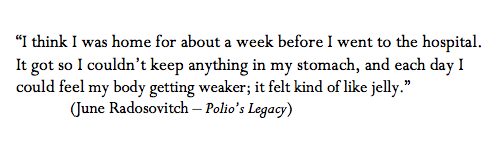
Screen shot 2013-05-13 at 5.51.07 PMYour stomach hurt.  Your head hurt even more.  Trembling chills canceled out the summer sun, and your throat was so sore it hurt to talk.  Those first few days were miserable, in a way I think we’ve all endured at one time or another: thoughts furred with fever, aching all over, too tired to move except during sleepless nights spent running back and forth to the bathroom.  Icky.  Exhausting.  But not the stuff of brimstone nightmares.

For all the hype about polio, unless you lived in the midst of a raging epidemic, at first the possibility occurred to almost no one.  The same mothers who forced children to touch chin to chest every time they came home from the playground, checking for the hallmark neck stiffness, sent their sick kids to bed with nothing but a couple of aspirin, and maybe a hot-water bottle to soothe slender, aching limbs.  Maybe it was self-defense.  Maybe it was just ignorance—ignorance to the real threat, subsumed by its distorted public image.  In the anxiety-ridden, war-torn first half of the twentieth century, you quite literally had to pick your battles, and every single tummy ache couldn’t trigger a full-on lockdown.

But however innocuous it looked on the surface, from the very beginning something was different.  There’s no one thing people can point to, asked to recall exactly why they felt so awful, but even in its early stages polio was something to be suffered, rather than merely waited out.  Everything about it threw the world off-balance: the overwhelming nausea, the disproportionate vertigo that made the ground seem to sway, the pricking pins and needles turning touch to sandpaper—intermittently now, and, as the illness progressed, in great drenching waves of skin-crawling sensation.

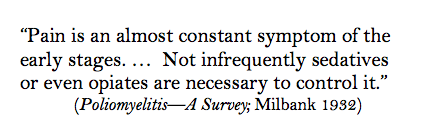
Children wept.  Adults wept, too, sometimes, or else they turned tense and irritable, hypervigilant with anxiety.  It’s possible the emotional sensitivity came of the viral scouting parties already mapping out territory in the brain, or it could have been something else; we probably won’t ever know for sure.  But the disease was such a profound misery that medical manuals often listed “inconsolable” behavior as a genuine symptom, one that contributed significantly to the likelihood of a positive diagnosis.Screen shot 2013-05-13 at 5.51.46 PM

Sometimes it got better.  Sometimes the fever broke, and stability returned, the nagging sense of the world viewed through a warped pane of glass dissipating overnight.  For the most part, those people never knew there had been anything so seriously wrong with them at all.  Never knew just how close they’d been to the kind of precipice that dissolves beneath your feet.  They blamed bad food at a barbeque, or that night they went to bed with hair still wet.  And then they carried on with their lives, the lucky ones.

But maybe you weren’t so lucky.  Maybe the headache that had merely nagged for days turned blinding, molten metal pouring down the nape of your neck until your whole spine was stiff as iron.  Maybe you hadn’t been able to keep anything down all weekend, and suddenly found you couldn’t even swallow the water in the glass you so unsteadily held.  Maybe the soreness in your calves, a strain that used to feel just like adolescent growing pains, turned overnight to cramps so bad they made you cry.

And the parent or partner to whom you’d confessed darted off to call the doctor, and left you to sit with the spark of terror you’d watched kindle in their eyes.

This was the moment of truth: the collision of your world with the hellish one you heard on the radio and saw in movie-theatre public service announcements, the one the media constructed to evoke pity and fear in equal measure.  There were so many things you should have suspected, but didn’t, precautions you ought to have taken, signs you should have seen.  Adrenaline made your stomach drop, this time, rather than nausea: what was going to happen now, if it was true?  Had you gotten somebody else sick?  What would become of your brothers and sisters, your parents, your kids?

What would become of you?

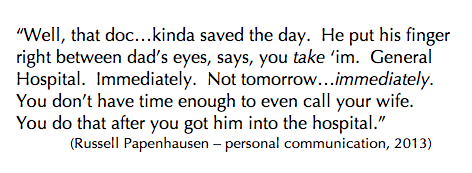
With very few exceptions, the doctor took one look—at the ginger way you held your body, how you winced at bright light, the limp as you walked or the unnaturally exaggerated curve of your spine—and sent you straight to the ER.

Screen shot 2013-05-13 at 5.52.21 PMThere you were met with either an overwhelming rush of activity or a long and interminable wait.  During an epidemic, lines stretched for hours, and only those already struggling for breath were allowed to skip ahead; if you had the misfortune of being the first case in town that season, the entire establishment descended on you in one predatory blink.  One way or the other, a single detail was constant: the forceful violation of the spinal tap, a single point of anguish to slice through the broad blur of misery.  Confirming a diagnosis required a sample of spinal fluid, collected by curling a victim already painfully rigid into a fetal position, and then sliding a thick needle between two vertebrae until clear liquid trickled out.

There was no anesthesia for this procedure; frequently there was no explanation for this procedure.  You might never have found out why it was necessary.  But you never, ever forgot it.

The instant the diagnosis was final, complete isolation began.  Children and parents (and husbands and wives) were separated, often by force; neither knew when they might see the other again, or if it might be in a coffin.

So then there was silence, and you were alone.

The fuss of admission and diagnosis gave way to the heavy void of solitary isolation, or the eerie quiet of an open polio ward, filled with the labored breathing of a dozen others just as sick, and the palpable tension of their own unspoken fears.  Still nauseous, still disoriented, likely still sore and headachy from the spinal tap, patients suddenly found themselves afflicted with something new: invisibility.

“I didn’t know what the hell was wrong with me,” Russell told me last week, fingers twisting together, gaze cast down to the kitchen table.  Russell, my interviewee, who fell ill when he was fourteen, and talks about it like it happened a year ago, instead of seventy-three.

“They didn’t tell you?” I asked, incredulous.

“Oh, they could’ve,” he shrugged, without missing a beat.  “But I probably didn’t understand what they were talking about.”

It’s a revealing thing to say: for all the paranoia surrounding the idea of the illness, hardly any of the kids it ensnared had any idea what it would look like if it assaulted them.  Neighbors worse off than you were terrifylifemagazineing, and wardmates in recovery, objects of seething, fevered envy; none of you had any idea what was going on.  Doctors dismissed the notion that even adults or teenagers had the right or ability to dictate their own medical care.  No one asked you what you wanted, what you needed, how you felt—or if you were okay with any of the many confusing, uncomfortable things they might be doing to you.

“I had a temperature of 106 for ten days,” one girl says matter-of-factly, in a book of short interviews called Polio Voices.  The brain is supposed to rebel against this sort of thing; the “thermostat” in the hypothalamus has this number set as its absolute upper limit, since at that point the risks start to outweigh the defensive benefits the body gets from running a fever.  It’s not necessarily dangerous, intrinsically, but it tells us something about how completely beholden to the virus its victims became, once it infiltrated the nervous system.  And once you were in the hospital, you couldn’t just go to the cabinet and pull down a couple of aspirin.  You couldn’t get up to walk to the bathroom—either because you were too weak, or because you were under strict orders not to exert yourself.  (It was thought—correctly, it seems—that any activity after the onset of spinal infection would worsen the ensuing paralysis.)

Screen shot 2013-05-13 at 5.51.40 PMThings crop up in these stories over and over again that would be horrifying if they happened just once.  The repetition gives them a kind of melancholy sadness, a strange, dark wonderment at the workings of this microcosmic world: just a cursory skim through the reminiscences in the books I’ve collected turned up three people who had overheard someone saying that they’d died.  To lie there in the dark, unable to wrestle away a sheet pulled up too high, lightheaded, breathing so shallowly the doctors apparently didn’t notice—the patients knew they were alive.  Maybe.  But everything about the illness was so surreal it’s hard to believe they were sure.

It felt like the world was ending, every illusion of comfort and safety shattered in a single sledgehammer blow, and you had nothing to do but sit at the window watching shards of clinging glass drip down one by one, and wonder what manner of demon would climb through the gap next.  And that dark inner world felt impossibly strange, pressed up against the bustling, well-lit one you lived in, where doctors hurried from one bed to the next saying words even adults didn’t understand, and except in the most horrible extremity the nurse showed up at the same times every day to give you juice and take your temperature.  The whole universe had gone mad, but except for the occasional shrieking outbursts of a roommate unable to cope or some poor soul down the hall, it wasn’t a derangement with any external confirmation.

The roiling sea—the riptides of fear, your churning stomach, the uncertainty of rescue and the Kraken lurking always just beneath the waves—was contained entirely inside you.  And who were you, so clueless, so sick, so unstable, to say if any of it was even real?  The doctors seemed indifferent, when they even noticed or remembered you were there.  Your body was betraying you, this shell you’d so thoughtlessly relied on in homeroom and games of kickball, at work and in the bedroom, and so why should you believe the blinding agony it felt?  Maybe the problem was just your delirium.  Maybe you were the problem.  Who was left that you could trust?orangeshirtgirl

So you did your best to stay quiet and composed, to be brave and not make a fuss, while sweat-crusted sheets rubbed your tender body raw.  The oceans of salt, at least, those were real: polio brings on drenching sweats—“diaphoresis,” in doctor-speak—out of proportion even to the fever.

And you waited.  Floating.

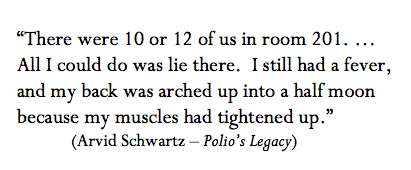
The brain is precious, and the body knows it.  Dying nerves—nerves dying, as I said in the last post, stretched and popping like overinflated balloons—don’t go quietly.  As the static on the line between the muscles and the brain grows louder, the illness shifts from a vague, squirming discomfort to a fierce and violent possession.  Muscle cramps far too powerful to stretch out lasted for days, so persistent that frequently they didn’t relax even after the fever broke.  A sensory condition called hyperaesthesia, in which normal sensations feel exaggerated and sometimes painful, made the pressure of the bedsheets so unbearable metal frames were used to keep them from touching patients.  Spasms and tremors shivered through burning-hot bodies, sometimes confined to an unsteady hand, other times triggering whole-body shocks like the ones that sometimes happen as you’re drifting off to sleep.

Leaving you at the mercy of a torturer you could neither see nor explain.  There was no wound to point at, no captor to loathe.  No amount of struggle made it any better; mental effort was exhausting, and most physical treatments just made the pain worse.  In many ways, this is far more terrifying than the notion of a sudden, sweeping paralysis: a body’s refusal to cooperate is scary—and sometimes infuriating—but not nearly as much so as being betrayed by it, backstabbed so primitively by something you couldn’t escape.

Screen shot 2013-05-13 at 5.51.53 PMThe specter of mortality was unrelenting, with silent bodies carried out through rooms still quietly full of life, and dire prognoses issued loudly at bedsides, as if their occupants were already too far gone to hear.  The constant humming wheeze of the iron lungs carried with it a very particular ambiguity: for a child feeling breathless in the dark—fatigued by dehydration, weak with creeping spinal infection—just the sight of the machine was a tremendous relief.  But if you went into that hulking contraption, would you ever come out again?  Most people did, after a few days or weeks of rest, letting the pressurized chamber do the work that tired breathing muscles couldn’t.  But some would stay there for the rest of their lives.  And lying there, growing weaker by the hour, exhausted and sometimes delirious, how could you possibly think about anything else?

The iron lung was the most famous intervention, but it was hardly the only one—and in many ways it was the least extreme.  Something called “convalescent serum” was crafted from the blood of polio survivors, on the premise that their antibodies would bolster the response of the immune system currently under assault.  Curare, an extremely potent poison, causes paralysis with a rapidity the poliovirus can only envy; the sick were sometimes put on ventilators and injected with the toxin, in case total motionlessness could slow the viral spread.  Vitamin injections irritated overtaxed bodies, and often did more harm than good.

texasscottishriteAll that’s just the medicine, though; the physical regimen was equally dramatic.  Some patients were immobilized in splints to keep them still, restrained like the mental patients they might have begun to empathize with, while shuddering involuntary movements swept through their bodies.  Others were bundled into steaming wool compresses and wrapped in rubber sheeting to relax their spastic muscles; this was one of the only effective interventions, but it must have been hard to believe it was doing any good, when the fever was so high they had to alternate heat therapy with rubdowns of ice.  The single most lifesaving revelation in the treatment of bulbar—brainstem—polio was the practice of tilting patients’ beds so their heads were inclined towards the ground, lower than the rest of their bodies.  Not because this made it any easier to breathe (that role, for those patients, was played by “rocking” beds, whose mechanized swing back and forth coerced the diaphragm into something like a normal pattern of expansion and contraction).  Because those patients often lacked the reflex power to swallow their own saliva, and letting it drain down their chins kept them from fatally choking.

Screen shot 2013-05-13 at 5.52.00 PMIn this firestorm of painful detail, I’ve lost the thread of the story I was telling.  Misplaced that anonymous person on that curiously beautiful day, the one sent so unceremoniously out to sea.  And maybe I’m making excuses for my own labyrinthine writing, my struggle to wring coherence out of this huge and elusive topic, but it feels appropriate, somehow.  All this skipping around is fitting: losing threads and finding them again, later, when the context has changed, and they seem to mean something else.  Being in this situation was a constant exercise in triangulation, struggling to figure out where you were—mentally, medically, spatially—and what the hell that meant.  Losing yourself, over and over again, and repeatedly rediscovering a person not quite the same as the one you’d left behind.

That was the person you’d have to carry back into the world with you, when all this was over.  Being sick with polio was awful.  But the acute illness was a thing with boundaries, a fever dream with a beginning and an end.  You woke up one day—a week into the trial, or maybe two or three—with sheets even more thoroughly soaked through than usual, and the sun was a little brighter, and your head a little clearer.  Gravity had tripled, and your body felt sore and reluctant, in the places that it worked at all.  The fever had broken, and a line had been crossed.  For some the moment came as a tremendous relief; for others, that first self-check felt more like a sentence handed down after a long, squeamish deliberation.  Maybe you’d be sent home, after a few weeks of recuperation, or maybe you’d be entering the scary, uncertain world of inpatient rehabilitation, but either way, one thing was true.  You no longer had polio.  You were a survivor.

And that was a thing that you never woke up from.

(Our Regularly Scheduled Programming)

01 Wednesday May 2013

Posted by victoria in Present Day

≈ Leave a comment

Tags

interviews, present day, real life

So that last post I made was very carefully engineered to have a follow-up within forty-eight hours or so…and then I spent the last forty-eight hours coordinating a hugely exciting interview instead, and driving halfway across the country to conduct it.

It’s tomorrow.  I can’t wait.

The cliffhanger might stick a little longer than anticipated.  But I’m still here.  Still working.  And hopefully I’ll have some big stuff to share very soon.

Image

Recent Posts

  • (More Than) A Thousand Words
  • Names, Phases
  • On Being Moved
  • Second Homes, Second Acts
  • Standing Tall

Archives

  • July 2013
  • June 2013
  • May 2013
  • April 2013

Categories

  • Introduction
  • Kenny Institute
  • Present Day
  • Real Life
  • Science
  • Society

Meta

  • Create account
  • Log in
  • Entries feed
  • Comments feed
  • WordPress.com

Blog at WordPress.com.

  • Subscribe Subscribed
    • A Louder Silence
    • Already have a WordPress.com account? Log in now.
    • A Louder Silence
    • Subscribe Subscribed
    • Sign up
    • Log in
    • Report this content
    • View site in Reader
    • Manage subscriptions
    • Collapse this bar
 

Loading Comments...